Radiator Pipe Covers and Flooring: The UK Questions Homeowners Ask Most
If you have just fitted new flooring, or you are planning to, there is a good chance you have reached the same slightly annoying point that many UK homeowners do.
The floor looks better. The room feels cleaner. Then your eye goes straight to the radiator pipes.
Maybe there is a rough hole around the pipe. Maybe the plastic collars look cheap next to the floor. Maybe the pipe is awkwardly close to the skirting. Or maybe you are just not sure what you are meant to buy in the first place.
That is exactly where most people get stuck.
This guide answers the most common real-world questions people ask when they are trying to make the area around radiator pipes look neater, especially after fitting laminate, engineered wood, LVT, or solid wood flooring.
Quick answer
If you want the short version, here it is:
- Yes, radiator pipe covers are one of the easiest ways to tidy the finish around floor entry points.
- In most UK homes, the main size choice is 15mm or 22mm.
- The usual style choice is 6mm for a slimmer look or 10mm for a fuller profile.
- Pipe covers work especially well when the flooring itself looks good but the pipe opening still feels unfinished.
- The two things people most often forget to check are pipe size and clearance near the wall, skirting, or valve.
If you want the area around your radiator pipes to stop looking like the last unfinished job in the room, this is usually the detail that solves it.
Why this is such a common problem
Radiator pipes are awkward because they sit right where the eye notices finishing quality most: at floor level, near skirting, and often in open view.
When new flooring goes down, even a small rough cut around a pipe can suddenly stand out much more than it did before. That is why people often end up searching for answers after the flooring is already in place.
It is not usually a major building problem. It is a finishing problem. But it is a finishing problem that affects how polished the whole room feels.
Can pipe covers actually make the floor look neater?
Yes, often very quickly.
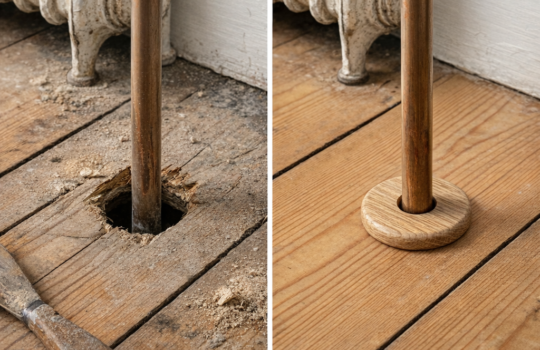
If the flooring is already down and the visible issue is the opening around the radiator pipe, a properly chosen pipe cover can make that area look far more intentional.
This is especially true when:
- the flooring is wood or wood-effect
- the gap around the pipe looks larger than you would like
- the old cover is white plastic and does not suit the room
- the floor has been upgraded but the pipe detail has not
In those situations, the pipe cover is not doing all the work on its own. It is simply finishing the one spot that keeps catching your attention.
That is why people often describe it as a small change that makes a bigger visual difference than expected.
Will radiator pipe covers hide a messy flooring cut?
Often yes, within reason.
If the cut around the pipe is untidy but not extreme, a pipe cover can usually clean up the appearance very effectively. This is one of the main reasons people buy them after laminate or engineered wood fitting.
That said, there is a limit.
If the hole around the pipe is unusually large, heavily chipped, or cut in an awkward shape, a cover may improve the look but not fully disguise poor workmanship. In those cases, the neatest result may come from a small repair first, followed by the cover.
A good honest rule is this:
If the floor opening looks slightly rough, a pipe cover will often sort it. If it looks dramatically oversized, a cover may still help, but it should not be expected to perform miracles.
Do you need to remove the radiator to fit them?
Usually no.
This is one of the biggest concerns people have, and it puts some buyers off before they have even looked properly at the options.
Most pipe covers are designed so they can be fitted around the pipe without removing the radiator. That is exactly why they are useful for finishing jobs after flooring has been installed.
For many homeowners, that is the real appeal. You get a neater result without turning a small cosmetic fix into a plumbing job.
If your setup is very tight, unusually awkward, or obstructed by other fittings, the area may still need a closer look. But in ordinary situations, removing the radiator is not the starting point.
What size do most UK homeowners need: 15mm or 22mm?
In most UK homes, the choice is between 15mm and 22mm or 10mm.
For many modern domestic radiator setups, 15mm is the more common size. 22mm does appear, especially in some older systems, certain larger pipe runs, or parts of the heating layout where a wider pipe has been used.
The important thing is not to guess.
Measure the outside diameter of the pipe itself, not the hole in the floor. If it measures around 15mm, choose 15mm. If it measures around 22mm, choose 22mm.
That sounds obvious, but it is one of the most common mistakes people make. They measure the gap around the pipe, or they estimate by eye, and end up ordering the wrong thing.
What is the difference between 6mm and 10mm?
Once you know the pipe size, the next question is usually style.
At Pipecover, the common profile options are 6mm and 10mm.
This is mainly a design choice:
- 6mm gives a slimmer, lower-profile look
- 10mm gives a slightly fuller, more defined finish
If your room is modern, minimal, or you want the pipe detail to fade into the background, 6mm is often the natural choice.
If your room has a richer wood tone, more traditional character, or you simply want the finishing detail to feel a little more substantial, 10mm can work very well.
Neither is automatically better. The right option is the one that looks most in proportion with the floor, skirting, and overall style of the room.
What if the pipe is very close to the wall or skirting?
This is one of the most practical concerns, and a very real one.
A cover can only fit cleanly if there is enough space around the pipe where it meets the floor. If the pipe sits extremely close to the skirting, wall, valve, clip, or bend, the cover may not sit properly.
Pipecover’s measuring guidance is useful here because it highlights not just pipe size but also clearance. Their covers use a 45mm outer diameter, so you need enough room in that area for the cover to sit without rubbing or clashing with nearby obstacles.
If the pipe is close to the wall, that does not always mean it is impossible. It simply means you should check the space properly before ordering rather than assuming all covers will fit the same way.
This is one of the most common “I wish I had checked that first” issues.
Will pipe covers work with laminate flooring?
Yes, in many cases they are especially useful with laminate.
Laminate often looks clean and uniform across the room, so any roughness around radiator pipes becomes more noticeable. Pipe covers can help soften that harsh little interruption and make the finish look more complete.
They are also a good fit for laminate because many people want a tidy result without lifting boards or disturbing the radiator once the floor is in.
The same logic often applies to engineered wood and some LVT installations too, although the visual effect will depend on the room and the finish you choose.
What about engineered wood, solid wood, or LVT?
These are all common situations where pipe covers can make sense.
With engineered wood or solid wood, the big advantage is visual matching. A wood pipe cover can look much more natural beside a real timber floor than a plastic collar does.
With LVT, the decision is often about contrast. Some homeowners prefer a very subtle finish around the pipe area, especially when the floor has a timber look and the rest of the room is clean-lined and modern.
The main thing is not the flooring category on its own. It is whether the area around the pipe still looks unfinished once the floor is down.
If it does, that is exactly the kind of problem a pipe cover is meant to solve.
Do pipe covers need to match the floor exactly?
Not always, but they do need to feel like they belong there.
This is another point people overthink, especially when they are trying to match oak, walnut, maple, or beech tones.
An exact perfect match is nice when you can get it, but in many rooms the better goal is a finish that looks coordinated and intentional. If the tone sits comfortably with the floor, skirting, and radiator area, that is often enough to make the whole thing feel right.
Pipecover’s wood options are useful here because they align with the kinds of finishes homeowners are already trying to match:
- Oak for a versatile classic look
- Walnut for darker, richer interiors
- Maple for pale, clean, modern spaces
- Beech for softer warmth and a more traditional feel
If you are deciding between two finishes, think about the room as a whole rather than staring only at the board colour in isolation.
Can they help if the floor fitter left bigger gaps around the pipes?
Sometimes yes, and this is one of the most common reasons people look for them after the flooring job is done.
A lot of homeowners are not starting from a perfect blank slate. They are trying to improve a result that is mostly fine, except for the pipe cuts.
If the fitter has left a slightly wider gap than expected, a cover can often make the area look much more deliberate. That is particularly helpful in visible rooms like lounges, bedrooms, and hallways where your eye keeps returning to that spot.
If the gap is very large, then the neater approach may be:
- repair or refine the worst of the opening if needed
- use a well-chosen cover to finish the area properly
That combination usually gives a better result than relying on filler alone, especially next to nicer flooring.
Are pipe covers just cosmetic, or do customers actually care?
They are cosmetic, but yes, customers do care.
In fact, that is exactly why they get searched so often. People may not think about radiator pipe collars at the start of a decorating project, but once the room is nearly finished, they suddenly become one of those details that is hard to ignore.
That is why these concerns keep appearing in homeowner discussions:
- “The floor looks great but the pipes don’t”
- “The old plastic collars look cheap”
- “The fitter left gaps around the pipes”
- “The pipe is too close to the wall”
- “I don’t know whether I need 15mm or 22mm”
- “Which finish will actually suit my floor?”
Those are not niche concerns. They are normal finishing-stage questions.
Is this a good job to sort now, or should it wait?
If the room is already being updated, it usually makes sense to sort it now.
Once new flooring is down, the unfinished pipe area tends to look more obvious, not less. Leaving it for later often means living with a detail that keeps bothering you every time you notice it.
This is especially true in early summer, when many UK homeowners are decorating, refreshing rooms, or wrapping up jobs they did not want to tackle during colder months.
It is exactly the kind of small finishing task that feels manageable and worthwhile at this point of year.
When might a standard pipe cover not be the right answer?
A standard solution may not be ideal if:
- the pipe is unusually close to the wall or valve
- the gap around the pipe is far larger than normal
- the area is damaged rather than simply unfinished
- you have a non-standard setup and need a more bespoke fit
Pipecover’s own contact guidance reflects this too. If you are unsure, it helps to check:
- the pipe size
- the gap you want to hide
- the finish you want
- any clearance issues around the wall, skirting, valve, clip, or bend
That is usually enough to tell whether a standard option is likely to sit neatly.
The simplest way to choose
If you want a straightforward buying checklist, use this:
- Measure the pipe itself and confirm whether it is 15mm or 22mm.
- Check there is enough clearance around the floor entry point for the cover to sit properly.
- Decide whether you want a 6mm slimmer look or a 10mm fuller one.
- Choose a wood finish that suits the room rather than chasing a perfect technical match.
- Be honest about whether you are covering a small untidy cut or trying to hide a much larger flooring issue.
That alone will answer most of the common concerns people have.
Final thought
The reason this topic comes up so often is simple: it sits right at the point where a room either looks finished or still looks like a job in progress.
For most UK homeowners, the real questions are not complicated. They want to know:
- will this tidy the gap?
- do I need 15mm or 22mm?
- should I choose 6mm or 10mm?
- will it work with my flooring?
- what if the pipe is close to the wall?
- can I make it look more natural than white plastic?
Those are exactly the questions worth answering clearly, because they are the questions that actually stop people from buying.
Done well, a pipe cover is not just a small accessory. It is the final detail that helps the whole room make sense.
FAQs
Can radiator pipe covers hide bad cuts in laminate flooring?
They can often improve the look significantly if the cut is slightly rough or wider than ideal. If the hole is very large or damaged, a repair first may give a better final result.
How do I know if I need 15mm or 22mm?
Measure the outside diameter of the pipe itself. Do not measure the hole in the floor.
What if the radiator pipe is very close to the skirting?
Check the clearance carefully before ordering. A cover needs enough room to sit properly, especially if the outer diameter is fixed.
Is 6mm or 10mm better?
Neither is universally better. 6mm is usually better for a slimmer, more subtle finish. 10mm suits rooms where a fuller profile looks more in proportion.
Do wooden pipe covers work better than plastic ones?
For many homeowners, yes, especially with wood or wood-effect flooring. They usually look warmer, more intentional, and less like an afterthought.
Do I need to remove the radiator to fit pipe covers?
In most ordinary cases, no. That is one of the main reasons people use them as a finishing solution after flooring has been installed.